When you begin searching for the perfect piece of jewelry to mark a milestone, the single most burning question on your mind is bound to be: what is the price of diamond ring options in the market right now?
The truth is, walking into a jewelry store or browsing online showrooms can be incredibly overwhelming. You might see one beautiful solitaire ring priced at $1,500, while another ring that looks nearly identical carries a staggering price tag of $12,000.
This dramatic price variation is not random, nor is it artificial markup. The final cost of fine jewelry is dictated by a traceable, logical combination of gemstone quality, raw materials, manufacturing labor, and market dynamics. In this comprehensive expert guide, we will pull back the curtain on the jewelry industry to answer exactly what is the price of diamond ring designs today, how the 4Cs influence that price, and how you can maximize your budget without compromising on beautiful sparkle.
Table of Contents
The Short Answer: What is the Price of Diamond Ring Options in 2026?
If you are looking for a quick baseline figure, the average price of a mainstream diamond engagement ring in the United States currently sits between $5,200 and $6,500. However, average figures can be misleading because they combine modest budget bands with ultra-luxury custom designs.
To give you a clearer and more realistic expectation, let’s look at how the total cost scales across different market categories in 2026:
- Entry-Level Tier ($1,000 – $3,000): This budget typically yields a high-quality 1-carat lab-grown diamond solitaire or a delicate 0.30 to 0.50-carat natural diamond set in 14K gold.
- Mid-Range Tier ($3,000 – $8,000): The most popular purchasing bracket. This range secures a beautiful 0.70 to 1.00-carat natural diamond with solid color and clarity grades, or a premium 1.5 to 2.0-carat lab-grown diamond in an intricate setting.
- Premium Luxury Tier ($8,000 – $20,000+): This level grants access to large, investment-grade natural diamonds (1.5 to 2.5+ carats) featuring top-tier colorless grades, flawless clarity, and heavy platinum or custom designer settings.

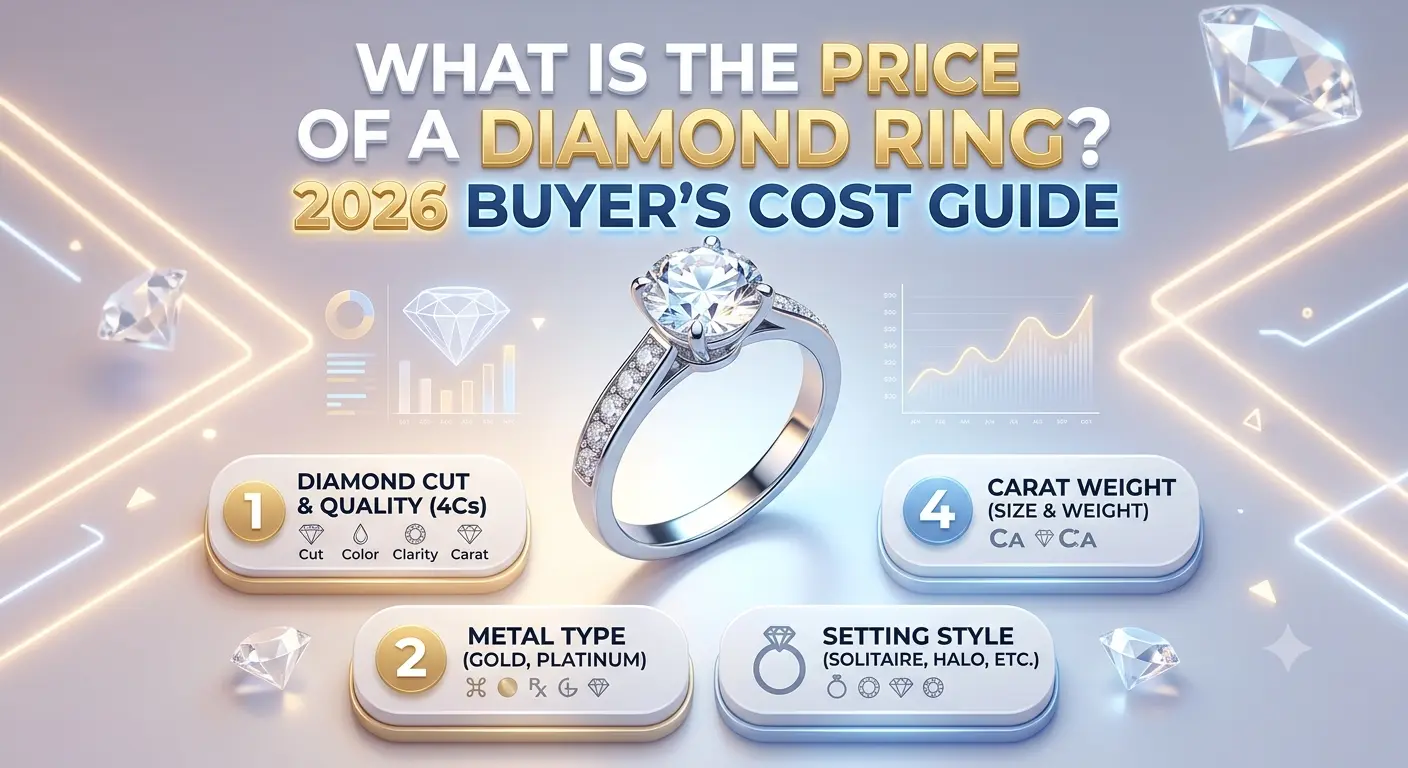
The Four Pillars: How the 4Cs Dictate the Price of Diamond Ring Settings
The gemstone itself is the most significant financial component of your purchase, frequently accounting for 60% to 80% of the total cost. To accurately determine what is the price of diamond ring styles you are eyeing, you must understand the globally accepted framework established by the Gemological Institute of America (GIA): the 4Cs.
1. Carat Weight (The Factor of Rarity)
Carat measures the physical weight of the diamond, not its physical dimensions. One carat equals exactly 200 milligrams. Because large diamonds are incredibly rare to discover in nature, diamond pricing does not scale linearly—it increases exponentially.
For instance, a 2.0-carat natural diamond will not cost double a 1.0-carat stone; it can easily cost three to four times more because of its sheer rarity.
2. Cut Quality (The Sparkle Engine)
Many gemologists consider the cut to be the single most crucial factor of all. The cut grade measures how precisely the stone’s facets interact with light to create fire, brilliance, and scintillation.
An “Excellent” or “Ideal” cut can add a premium of up to 25% to the stone’s cost. However, it is worth every penny—a well-cut diamond returns maximum light, making the stone appear larger and livelier on the hand, whereas a poorly cut stone will look dull and dark regardless of its size.
3. Color Grading (The Tint Scale)
White diamonds are graded on a letter scale running from D (completely colorless) to Z (noticeable light yellow or brown) tint.
- D-F (Colorless): The rarest and most expensive tier.
- G-J (Near-Colorless): These stones offer an incredible value. To the untrained, naked eye, a G or H color diamond looks perfectly icy and white, but it costs a fraction of a D-color premium stone.
4. Clarity (Nature’s Fingerprints)
Clarity measures the presence of internal characteristics called “inclusions” or surface flaws called “blemishes” that occurred during the stone’s formation deep within the earth. The scale ranges from Flawless (FL) down to Included (I3).
For smart shoppers calculating what is the price of diamond ring pieces that fit a balanced budget, VS1 or VS2 (Very Slightly Included) and SI1 (Slightly Included) grades are the sweet spot. These stones are “eye-clean,” meaning their tiny imperfections are completely invisible without a professional jeweler’s magnification loupe.
Natural Mined vs. Lab-Grown: The Modern Pricing Revolution
You cannot thoroughly answer what is the price of diamond ring products in the modern era without addressing the structural shift caused by lab-grown gemstones.
Lab-grown diamonds are physically, chemically, and optically identical to natural diamonds dug out of the earth. They possess the exact same atomic structure, the same level of hardness (10 on the Mohs scale), and identical optical brilliance. They are certified by the same elite labs like the GIA and IGI.
The only difference is their origin—and their price tag. Because laboratory production can scale efficiently, lab-grown diamonds cost roughly 60% to 80% less than natural stones in 2026.
| Diamond Weight & Type | Loose Stone Price Range | Estimated Price in a Solid 14K Gold Setting |
| 0.50 Carat Lab-Grown | $300 – $600 | $1,200 – $2,200 |
| 0.50 Carat Natural Mined | $1,200 – $2,500 | $2,500 – $4,500 |
| 1.00 Carat Lab-Grown | $800 – $1,500 | $2,500 – $4,500 |
| 1.00 Carat Natural Mined | $4,000 – $6,500 | $6,000 – $12,000 |
| 2.00 Carat Lab-Grown | $1,800 – $3,500 | $5,000 – $9,500 |
| 2.00 Carat Natural Mined | $12,000 – $25,000+ | $18,000 – $35,000+ |
Choosing between the two depends entirely on your personal philosophy. If you view your ring as a traditional heirloom that must hold long-term market resale value, natural mined stones are the standard. If your priority is maximizing visual size, carat weight, and pristine clarity for your immediate budget, lab-grown alternatives offer unparalleled value.

Beyond the Stone: Metal Settings, Craftsmanship, and Hidden Costs
While the center gemstone takes up the bulk of your budget, a finished piece of jewelry requires a metal setting, skilled artisan labor, and legal compliance. These factors add up quickly to shape what is the price of diamond ring options globally.
Choosing Your Precious Metal
The weight, purity, and type of metal you choose for your ring band will heavily influence the baseline cost:
- Platinum: The most premium option. It is naturally hypoallergenic, incredibly dense, and highly durable. Because it is heavier than gold, a platinum setting will add a higher cost to your total bill, but it requires less maintenance over a lifetime.
- 18K Gold (75% Pure Gold): The luxury standard for gold jewelry. It offers a rich, beautiful color and provides a secure hold for precious gemstones.
- 14K Gold (58.5% Pure Gold): The practical champion. It is mixed with a higher percentage of durable alloys, making it highly scratch-resistant and more affordable than 18K or platinum, without compromising aesthetic beauty.
Labor, Making Charges, and Taxes
Crafting custom jewelry requires meticulous work. “Making charges” or labor costs can account for 8% to 25% of the ring’s value, depending on how intricate the design is. A simple, classic four-prong solitaire band has minimal labor costs. Conversely, a ring featuring a pavé band (covered in dozens of micro-diamonds), a hidden halo, or intricate vintage hand-engraving will demand premium artisan wages.
Additionally, always remember to account for regional taxation (such as GST or state sales taxes), jewelry insurance policies, and potential resizing fees when calculating your true bottom-line budget.
Insider Tips: How to Maximize Your Diamond Ring Budget
If you want a breathtaking ring but need to keep costs under control, use these insider industry secrets to outsmart standard retail pricing structures:
- Buy Shy of the Carat Threshold: Diamond prices spike drastically at whole numbers like 1.00 ct, 1.50 ct, or 2.00 ct. If you purchase a 0.92-carat stone instead of a full 1.00-carat stone, it will look completely indistinguishable in size to the naked eye, but you can save up to 20% on the price.
- Prioritize Cut Over Clarity and Color: A diamond with an Excellent cut but slightly lower color (H or I) and clarity (SI1) will look significantly more radiant and expensive than a Flawless, D-color stone that is poorly cut and lacks sparkle.
- Leverage Elongated Fancy Shapes: Round brilliant cut diamonds are the most expensive shape on the market because they waste the most raw crystal material during the cutting process. Fancy shapes like Oval, Pear, Marquise, or Emerald cuts not only cost less per carat, but their elongated profiles also create a larger visual appearance on the finger.
Conclusion
Ultimately, discovering what is the price of diamond ring jewelry reveals that there is no singular, rigid answer. The cost is a dynamic spectrum governed by your choices across the 4Cs, your preference between natural or lab-grown origins, and the complexity of the precious metal setting.
The old-school retail rule stating that a buyer must spend three months of their salary on an engagement ring is entirely outdated. Today’s smart consumers focus on understanding the underlying quality factors, setting a strict, comfortable personal budget, and working with certified, transparent jewelers who provide independent grading reports from trusted entities like the GIA or IGI. By prioritizing cut quality and balancing the other characteristics wisely, you can find a stunning, brilliant ring that symbolizes your love perfectly without compromising your financial well-being.

Frequently Asked Questions (FAQs)
Q1: Why do two diamond rings of the exact same size have vastly different prices?
Carat weight is only one-fourth of the pricing equation. Two rings featuring identical 1-carat stones can vary by thousands of dollars because one might possess a flawless clarity grade and perfectly colorless tint, while the other contains visible natural inclusions and a yellowish undertone.
Q2: Do diamond rings hold their resale value over time?
Certified natural diamonds retain stable long-term value, but you should expect to recoup around 40% to 60% of the retail price if selling to a jeweler, due to retail markups and industry profit margins. Lab-grown diamonds, due to rapidly scaling supply, generally do not hold strong secondary market resale value.
Q3: What is the smartest budget range for a high-quality 1-carat diamond ring?
For buyers prioritizing value, a budget of $2,500 to $4,500 is the sweet spot. In this range, you can secure a stunning, certified 1-carat lab-grown diamond with premium cut, color, and clarity grades housed in a solid 18K gold or platinum setting.
Q4: Is a lab-grown diamond ring considered real jewelry?
Yes, absolutely. Lab-grown diamonds are 100% real diamonds. They are not fakes or simulants like cubic zirconia or moissanite. They have the exact same chemical, physical, and optical attributes as mined gems.
Q5: Is platinum better than white gold for a diamond setting?
Platinum is highly recommended for its strength and longevity; it does not change color over time. White gold is lighter and more affordable initially, but it requires periodic rhodium replating every few years to maintain its bright, icy-white finish.